
Pricing on request. Contact sales@cryomagnetics.com or your local sales representative for a quote.
Room Temperature Bore Superconducting Magnet Systems
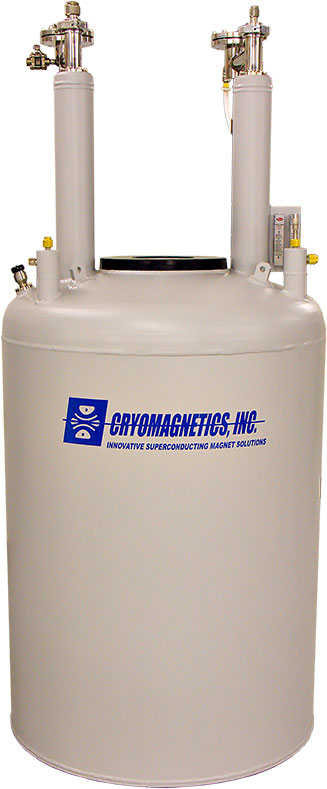
Cryomagnetics liquid-helium room temperature bore superconducting magnet systems are available in vertical or horizontal configurations — solenoids to 20T and split-pairs to 11T — designed to ASME code for NMR, gyrotron, ICR, magnetic separation, and other applications.
Cryomagnetics' experience in manufacturing room temperature bore, liquid helium (wet) systems for advanced research is unmatched.
As with bucket dewar systems, there is a wide variety of superconducting magnet configurations available. Some include solenoids up to 20 Tesla, split-pairs up to 11 Tesla, multiple-axis, and custom designs to your specifications.
The room temperature bore can be configured in the vertical or horizontal plane. Vertical bore configurations are very popular for NMR research, gyrotrons, magnetic separation, and many other applications. Variable temperature cryostats and other stand-alone inserts such as dilution refrigerators are used with vertical room temperature bore systems.
Horizontal room temperature bore systems are popular with Ion Cyclotron Resonance research and ion-trap applications. As with vertical bore configurations, the applications for horizontal bore superconducting magnet systems are almost endless.
Room temperature bore systems are designed with your particular needs in mind. Ultra-loss loss, vertical bore NMR systems are designed with very long liquid helium hold times. Magnetic separation systems are designed to handle large forces to the superconducting magnet, while maintaining good liquid cryogen loss performance. Gyrotron systems are designed with strict magnetic field to dewar alignment specifications while meeting stringent liquid cryogen loss performance. No matter what your application, Cryomagnetics can design to your needs and deliver a system to economically and efficiently aid your research.
To minimize liquid helium usage, Cryomagnetics will optimize current lead configuations to match your experiment schedule. For example, superconducting magnets used mainly in persistent mode can be provided with fixed current leads that have as little as 30mL/hour LHe boiloff in static mode.
For superconducting magnets used mainly in swept mode operation, current leads can be optimized so liquid helium usage does not become excessive when high current is applied. Special high-resistance persistent switches can also be installed on these magnets to help minimize liquid helium usage during magnetic sweeps.
In systems that remain in persistent mode for extended periods of time, retractable current leads may be the best solution. High temperature superconducting (HTS) current leads may be advantageous in some room temperature bore applications.
Hall effect and temperature sensors can be installed on the superconducting magnet to monitor system status.
Designed with safety in mind, all Cryomagnetics room temperature bore systems are designed to ASME code.
Superconducting Magnet, Model 100-475-050
Solenoid configuration
10 Tesla central field (4.2K) at approximately 98 amperes
No 2.2K rating
± 0.5% central field homogeneity over a 10 mm DSV
Persistent mode switch installed
Fully protected against damage due to quench
Fully tested at 4.2K
Superconducting Magnet Dewar
Vertical room temperature bore configuration
Welded aluminum construction
Retractable superconducting current leads installed
Usable liquid helium volume of approximately 50 liters
Estimated liquid helium loss rate of < 125 mL/hour (dewar in thermal equilibrium, current leads retracted)
LN2 shielded
Evacuation valve, safety positive pressure relief devices
2.75 inches inside room temperature bore diameter
Superconducting magnet bus bars
Magnet supports
Dual (redundant) liquid helium level sensors installed
One removable liquid nitrogen level sensor installed
15 foot long instrumentation cable
LHe fill/vent ports
Lifting lugs
LN2 precool/removal tube
Quench relief valve
Redundant one PSI safety pressure relief valve